A PSL score is a structured photo estimate, not a permanent label of your appearance or an absolute truth about your identity. If you want to understand how PSL score works, it fundamentally comes down to checking specific points on your face and normalizing the geometric relationships between them. This guide explains the underlying PSL scoring method, the specific measurements used, and exactly how PSL rating is calculated.
The PSL Scoring Method: Browser-Based Landmarks
When you upload an image, FreePSLScore runs a local face landmark model directly in your web browser. The first thing the algorithm does is check whether one usable, clearly visible face is present in the frame.
Once a face is successfully detected, the model maps out key geometric points—known as facial landmarks—across your eyes, nose, mouth, cheeks, and jawline. By normalizing the distances between these points, the PSL scoring method calculates facial proportions rather than absolute physical sizes. These category signals are then weighted and combined into a final Basic PSL Estimate, which is rounded to one decimal place on a 1.0–8.0 output range.
Combining Four Visual Categories
Our basic face rating tool does not look at your skin clarity, eye color, or personal styling. Instead, it combines four distinct visual categories to generate a directional estimate:
- Harmony (35%): Evaluates how consistently the main facial proportions read together as a cohesive whole.
- Symmetry (30%): Measures how closely selected left and right facial landmarks mirror each other in the uploaded image.
- Angularity (20%): Looks at the visible definition of the lower face, primarily through jaw width relative to overall face width in the uploaded image.
- Dimorphism (15%): A limited geometric signal based on specific eye and jaw measurements.
These categories offer a compact, structured way to discuss a photo. However, they do not measure personality, identity, health, voice, style, or real-world attraction.
How PSL Rating Is Calculated: Core Measurements
A common misconception is that a rating relies on one perfect feature or a single, secret beauty formula. In reality, the score combines selected normalized relationships from the visible geometry in the uploaded photo. Here is exactly what the PSL scoring method measures for each category:
- Harmony: This category measures how the selected facial proportions work together. To calculate this, the algorithm evaluates your eye spacing, mouth width, nose length, and lower-third ratio.
- Symmetry: This metric captures the visible balance in the uploaded photo. The model specifically maps and compares mirrored left and right eye, mouth, cheek, and face-width facial landmarks.
- Angularity: To estimate visible lower-face definition in this image, the tool primarily analyzes jaw width relative to overall face width.
- Dimorphism: This is a limited geometric category based strictly on eye opening, brow depth, and jaw proportion. It is purely mathematical and is not a gender or identity judgment.
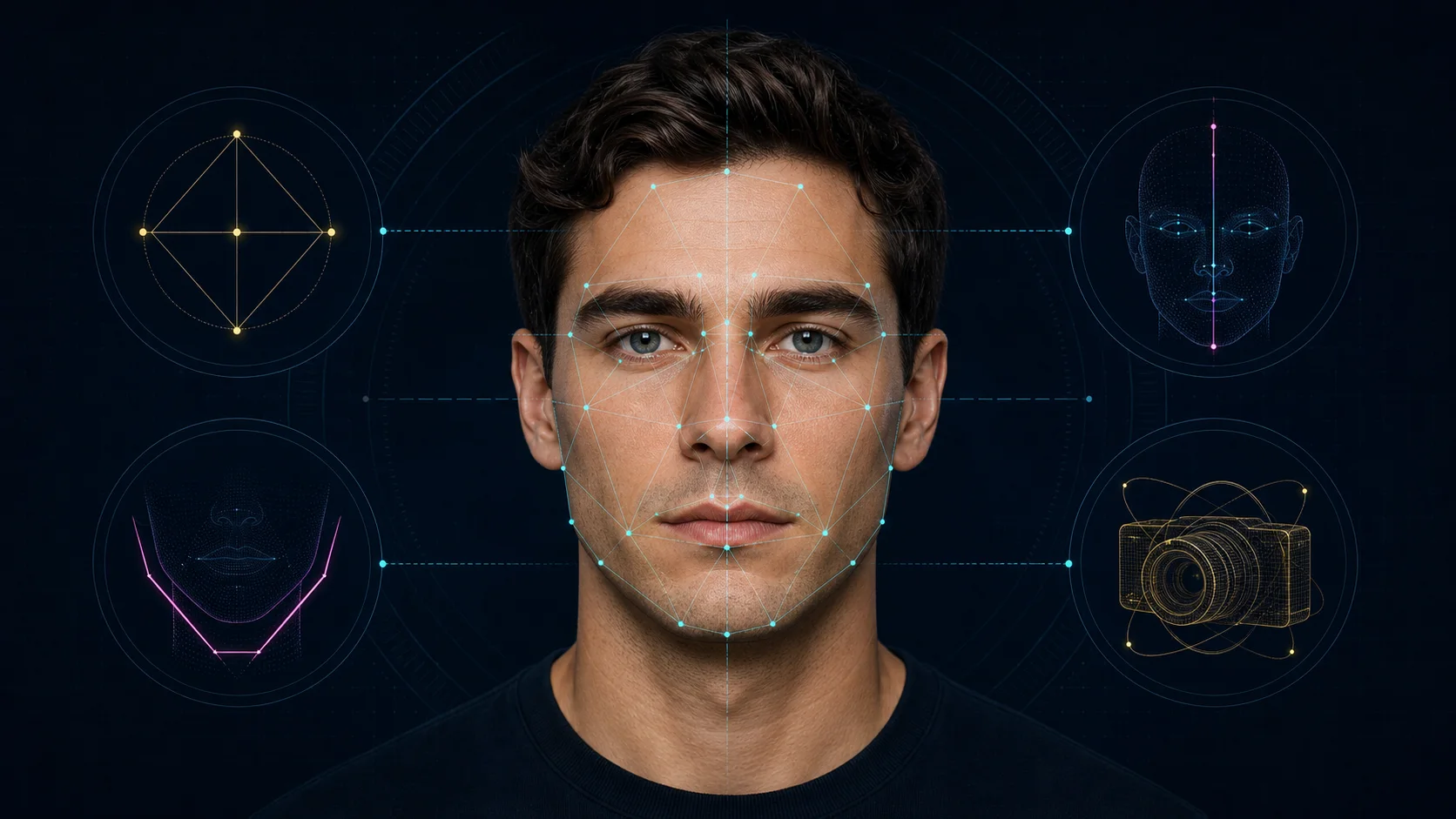
Illustrative landmark method — four visual dimensions contribute to one directional estimate.
What We Do Not Measure: Golden Ratio and Hunter Eyes
Because the system relies exclusively on the facial landmarks listed above, the result is a directional photo estimate, not a complete attractiveness assessment. It is crucial to understand the boundaries of this tool.
First, the calculator does not use the golden ratio. FreePSLScore relies on several normalized facial proportions rather than treating one single golden-ratio formula as a universal standard.
Second, the tool does not separately score internet-popular traits like hunter eyes or canthal tilt. Our current output does not provide separate hunter-eyes, canthal-tilt, or lip scores. While measurements like eye spacing and eye opening naturally contribute to broader categories, the tool does not label a specific eye shape as a standalone result.
What Does “Accuracy” Mean Here?
When discussing an AI face rating, it is important to note that there is no official scientific formula to validate against. Therefore, in the context of this tool, a more useful definition of quality is consistency. We ensure the method is clearly explained, the same photo can be rerun to achieve the same result, and failed inputs are rejected instead of being forced into an inaccurate score.
Our output always explicitly shows its limits. This is why the result is labeled a Basic PSL Estimate. It is a browser-based visual exercise intended for entertainment and self-reflection, not medical advice, psychological assessment, or proof of personal value. A higher or lower number should never be used to make decisions about a person’s health or identity.
The Deep Analysis (3-Photo Stability Check)
One photo is enough to start. The free Standard result provides the preview; US$9.90 buys one complete Deep report, or US$29.90 buys a pack of ten. Both include the same dimension explanations and downloads. The ten-report pack includes the first report plus nine additional report allowances valid for one year. After payment, optionally add one or two different front-facing photos, then confirm generation once. A single-photo report preserves the original reading; two-photo dimensions use an average, and three-photo dimensions use a median. Only multi-photo reports show consistency and observed ranges. Consistency describes agreement, not accuracy. Photos stay in your browser; saved reports contain derived scores, ratios and available photo-position checks. Reopening a saved report does not use another report allowance. This is a one-time purchase, not a subscription.
Each report includes six optional AI styling previews without spending image credits. Only the ten-report pack grants 100 bonus image credits in total, once per purchase and shared across its reports. The single-report plan includes no bonus image credits. Only extra images you actively choose to generate cost 10 credits each. Styling sends your selected photo to the image provider after your separate consent.
Each photo is checked locally before the results are compared. The result appears as soon as processing finishes; the time depends on your device and whether the face model has already loaded. Deep mode does not add a fixed bonus to your rating. It is strictly intended to show whether the estimate stays in a similar range across consistent views, not to manufacture a more flattering score.
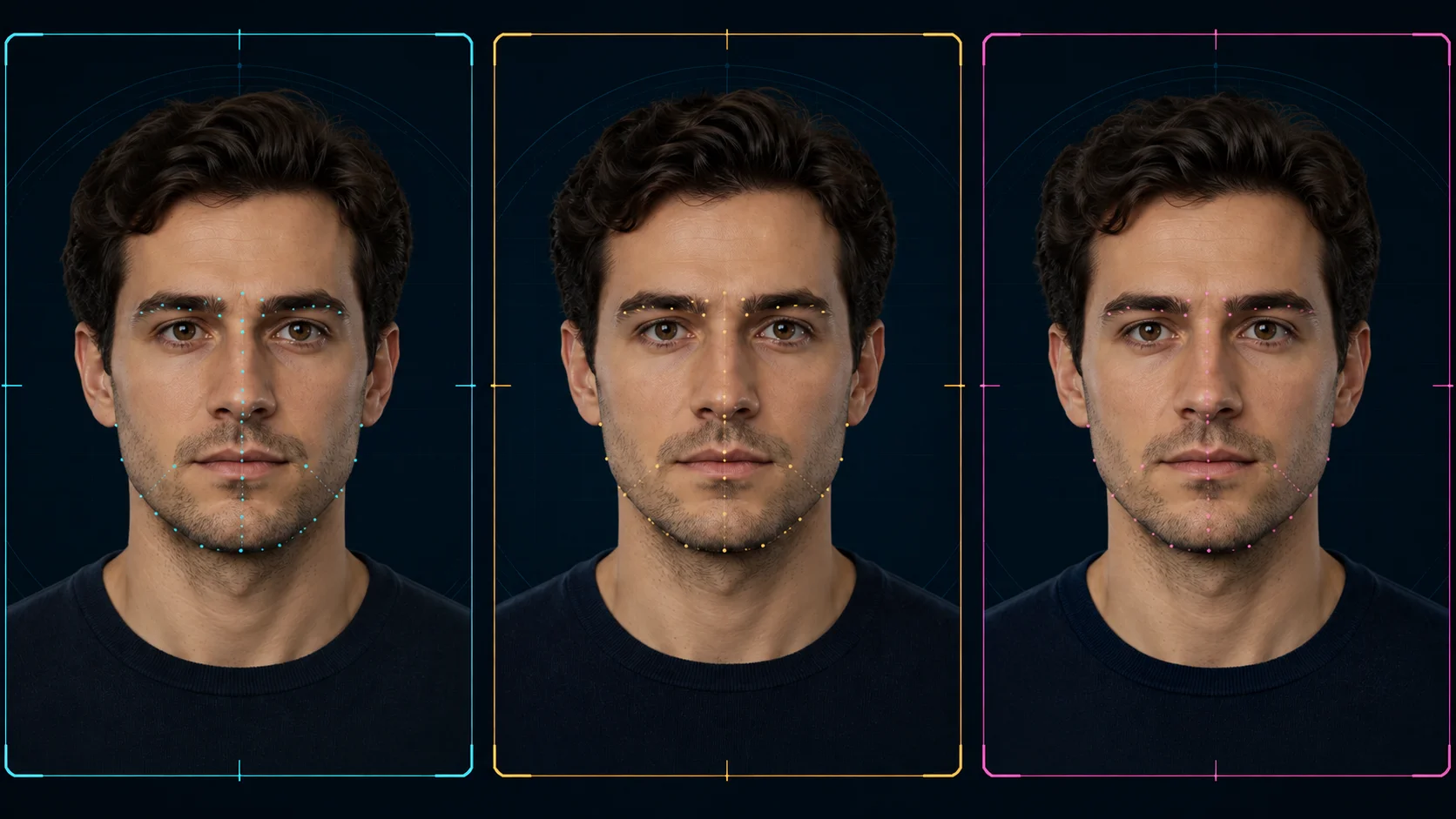
Three front-facing captures — fictional portraits illustrating consistent lighting and camera distance. Take a new photo for each slot.
Frequently Asked Questions
How is a PSL rating calculated?
The system uses a browser-based model to map specific facial landmarks. It then normalizes the distances between these points to evaluate facial proportions, symmetry, angularity, and dimorphism.
Does the tool use the golden ratio?
No. FreePSLScore uses several normalized geometric relationships rather than treating one golden-ratio formula as a universal standard.
Does it separately score hunter eyes or canthal tilt?
No. The current output does not provide separate hunter-eyes or canthal-tilt scores. Eye spacing and eye opening contribute to broader categories, but the tool does not label a specific eye shape as a standalone result.
Can I use a side-profile photo for the test?
Both Standard and Deep analysis require front-facing photos. Deep optionally compares up to three separate selfies taken with a level head and consistent lighting; it does not provide a side-profile rating.
Why can two tests give me different scores?
Camera distance, crop, expression, head position, and shadows all physically change the visible geometry detected by the model. For a useful comparison, you must repeat the exact same photo conditions and analysis mode.
Try a Free PSL Score Test
Use one clear photo to start the test. If the image is rejected, follow the photo checklist instead of treating the error as a low rating.